My takeaway from the course

The Gutenberg to the web course has been extremely eye opening for me. It has been a very long 3 weeks, but I also gained so much information and learned so much in the tightly packed schedule. After already being in France for a week, I first met the group in Paris. From that very first day in Paris, I immediately clicked with some amazing people. According to my Fitbit, we traveled about 23 miles on foot, which is almost the same as a full marathon. While roaming around, we ran into the yellow jacket protests that have been occurring for a while in France. For our topic in class before the trip, Abby and I talked about the Charlie Hebdo attack that occurred in Paris just 4 years ago. This attack brought on many protests. However, the protests in 2015 were considerably voluminous compared to the ones we stumbled into. It really made me realize how important and massive the protests were after the Charlie Hebdo attack. Even though the protests were for different reasons, it is ample to have something to compare it to.

On our final day in Paris, we visited the Musée des Arts et Métiers. thought it was very fitting to start with this museum and end in Berlin at the German Technological Museum. Both had an abundant amount of similarities, but were also extremely disparate. The Musée des Arts et Métiers consisted of 19thcentury technology including biplanes, printing presses, and even grandfather clocks. The German Technological Museum also consisted of retro technology, however also really showed the advancement we have in technology today. I felt as though the museum today really made you think about how media has advanced.

From this course, I took away a lot. But I think the main point I got out of it was how quickly media has evolved. Around the 1450s, Gutenberg invented movable type with a printing press. Without this man, we would not be where we are today in terms of technology. With the Gutenberg museum, as well as the Musée des Arts et Métiers, it was clear to see how difficult it was to make copies or create texts. At the Gutenberg museum in Mainz, we had our own printing workshop, and I was absolutely terrible at it. This taught me that printing took a lot of practice, time, and hard work. It only takes the click of a button today to create the years of hard work back then.

With the evolution of media, unfortunately came propaganda. Another huge takeaway I got from this course. This was an extremely difficult topic to cover. I stepped in the same path Hitler did in the 1930s, as well as the millions of Jews that were murdered at Auschwitz in the 1940s. Hitler had an immense number of admirers, which was only with the help of media and propaganda. He was seen as a hero in films and on television. To see all of this in person, and be on the same grounds where it all took place was very chilling. Although it was a horrific subject matter, it definitely opened my eyes to how easy media can be used to change people’s views, even if it is just the way a camera is angled.

We were told not to write that much for this blog, however it is hard not to. I have so much to say and could talk about what I have learned for hours. All in all, I took away a lot from the Gutenberg to the web course. Communications has quickly evolved and still continues to today. I also made some amazing friends who I believe will be lifelong friends. I also feel very travel savvy, since I basically navigated my friends to every single place we went. I learned a lot about myself as well as others. I think that traveling and stepping outside of my comfort zone is an incredible way to be more understanding. I learned so much about the French, Polish, and German cultures, and will want to continue to learn more. I definitely want to come back one day.

-Theresa Prayther
Reflecting on Auschwitz

I just want to start off by saying that the words I say in this post will not even come close to the feelings and experience I had today at Auschwitz. It is actually extremely difficult for me to write this because I am honestly still trying to process what I saw.

Today, I laid foot on the largest Nazi concentration and death camp. As soon as I pushed through the turn stile and saw the words “Arbeit Macht Frei” my heart sunk to my feet. It felt absolutely unreal that I was standing where hundreds of thousands of people were brutally tortured and killed. There was a melancholy presence while I was walking through the gate. There was even a sense of guilt that rushed through me while treading through the mud and snow of the camp. It seemed unfair that I was able to walk here today. My footprints followed those of men, women, and even children who may have never made it back outside.

While stepping into one of the blocks, my tour guide mentioned that she was not going to speak a lot because she believed it spoke for itself. And that it did. I saw mountainous piles of hair, shoes, hairbrushes, suitcases, pots, etc. that belonged to, and were taken away from prisoners. These people had no idea what was about to happen to them. The enormous piles of personal possessions illustrate this. Once they got to Auschwitz, these items were never to be seen again.

One thing that indubitably stood out to me was when my group walked out of a block and into a courtyard that consisted of the extermination wall. Two by two, prisoners were sent outside, the same way my group walked, and faced the infamous wall. They were then shot in the back of the head. I was standing behind the group as they were observing the extermination wall. I instantly pictured the prisoners with their backs facing just as my group was. I had a horrifying image of the lifeless bodies just hitting the ground after receiving a bullet to their head. Families, however, were all killed together. So, then I pictured me and my own family, standing there together, trembling, and having everything be over within the second.

All of the thoughts and emotions I experienced today can be formed into an entire book. For my own health, I need to stop writing here. There is just a lot of information I am trying to still take in and it is hard for me to write when I can’t even come to terms with my own feelings. Every thought that passed through my head was needed for me to truly put everything into perspective. I will end by saying, I will never forget today.

Examining the role of communication in Hitler’s dictatorship 

Originally, Auschwitz was meant for political prisoners. Then came the Jews, homosexuals, gypsies, people with disabilities and anyone who threatened the superiority of the Third Reich.

However, it’s important to note that labor and extermination camps started with the most outspoken critics of Hitler’s dictatorship­––– political enemies of Hitler’s regime.

This includes communists, academics, journalists and anyone else who threatened the German dictatorship.

Yesterday, we saw death lists of political prisoners published by the Nazis displayed in the Schindler Museum in Krakow. The list consisted of more than thirty names of Polish prisoners their death sentences. This begs the question––– why did the Nazis feel the need to advertise death when their concentration camps were hidden from the rest of the world?

The only word that comes to mind is fear.

Former Abwehr (German Secret Police) chief Maj Wieser explained the concept of fear through the press in a letter. He wrote, “We can expect that the publication of such details will reach wider circles of the Polish population and terrorize them into submission.”

Throughout this course, we’ve focused on the beginning of Gutenberg’s press and the  expansion of print accessibility to the masses. However, for the Nazis, Gutenberg’s groundbreaking invention contributed to the death of millions of innocent people. In particular, printers were used by the Nazis to incite fear and public discord in Poland at the beginning of World War II. The death list posted in public places of deceased political prisoners became synonymous with the reminder of a bullet. Every newspaper article published from German “news” media was a reminder of the Nazi’s unwavering power. As a result, more than 500,000 Poles were drafted by the Nazis at the cusp of the war, while others deemed inferior were sent to work campus such as Auschwitz and Birkenau.

Even so, one of the most horrifying aspects of visiting Auschwitz and Birkenau was the fact that it was completely hidden from the public view during World War II. Despite publicizing the deaths of political prisoners, the Nazis never wanted the public to know what actually happened inside the concentration camps. They covered their tracks through strict nomenclature. For example, the eradication of Jews was described as their “Resettlement.” Gas chambers were “Disinfection” rooms. In addition, the Nazis hid and burned any literature with any reference to their twisted acts of horror towards those deemed “inferior”; however, their gas chamber plans were recovered in the end.

It is truly mind-blowing when people deny actions of their own atrocities through hiding their meaning to others. All we can do is remember and reflect. And hope the misuse of rhetoric doesn’t lead us down paths that end in blood and barbed wire.

-Theresa Prayther and Abby Gibbs

Nazis and Propaganda

On January 8, 2019,  our group visited the Documentation Center Exhibition in Nuremberg. The building of the museum consists of the unfinished Congress Hall of the former Nazi party rallies. This infamous site paints a picture on how propaganda was displayed throughout the 1930s through a series of short films and displays of information. By holding an audio translator to our ears, we came to learn the causes, rationality, and effects of National Socialism through the media. Hitler used propaganda to gain support of German so that he could obtain more power.

Propaganda is defined as information, displayed through the media, that may be misleading in order to influence the public opinion. Leni Riefenstahl, a skilled cinematographer and creator of many propaganda films, created a few films for Hitler about Nuremberg rallies. The way she created these films made it seem like Hitler was a hero.

Unfortunately, propaganda still works today. There are striking similarities between Hitler’s rise to power and the media being published today. The Nazi party was able to shutdown mainstream media credibility. Today, many journalists are not trusted by the government and are slowly being destroyed. It was very interesting, and quite chilling, to make connections when eerie information was projected into our ears.

The Journey Begins in Paris, France

IMG_4659.JPG

“A walk about Paris will provide lessons in history, beauty, and in the point of Life.” – Thomas Jefferson


Day 1: Paris, France

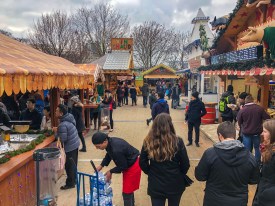
After being in France for a week prior to the course, I finally met up with the group. Although very zombielike from the plane ride to France, we had a very eventful first day in Paris. While walking toward the Louvre, a few of us came across a small Christmas market nearby. The market contained a vast array booths of food and small items for sale. As we took our first step into the market, we immediately caught an aroma of breads and meats.

IMG_4365.JPG

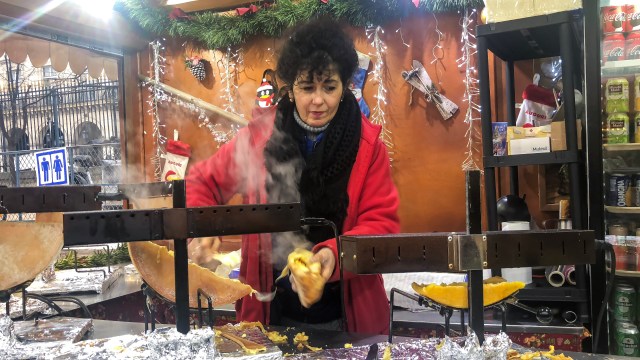
What caught my eye instantly was a booth to my left, which is seen slightly in the picture above. I was in awe of the woman scraping the melted cheese onto the fresh baguette with meat. This is known as a raclette, which I have never tried before. Unfortunately, the group I was with was walking from a small café we just ate at. Our stomachs were full, which we regretted once we stepped into the Christmas market. However, we knew we would have time the next day to come back and eat lunch. So, we did exactly that.

Day 2:

The next morning, I could only think about the raclette after laying my eyes on it yesterday. The same group of us decided to go back to the Christmas market for lunch. I immediately got in line to get the sandwich I could not stop talking about.

IMG_4544.JPG

Here is woman scraping the perfectly warmed cheese onto my baguette with prosciutto. I was in awe, and super excited to try something new.

IMG_4547.JPG

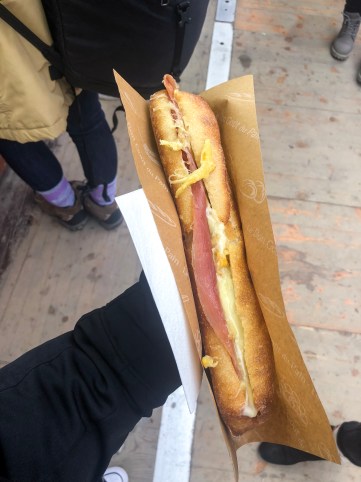
She handed me my raclette and of course I needed to take a picture of it before eating it.

IMG_1080.jpg

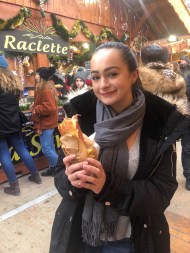
As I took the first bite, the warm cheese hit my tongue and I instantly fell in love. Out of the many food stands at the market, I do not regret picking this one. With the limited time in Paris, I wanted to challenge myself to try something new. Although a raclette is very simple, once I saw it I knew I needed to try it.

I can say that I am very satisfied with my decision. I hope to have another raclette, and maybe I can even make one on my own. I would love to have my family try one and share my experience with them. We may just have to come back to Paris to get one together (I hope my Mom is reading this). I am very grateful I was able to spend time in Paris. Although our time in Paris is at an end, we our only beginning our journey. Now onto Germany!

-Theresa Prayther