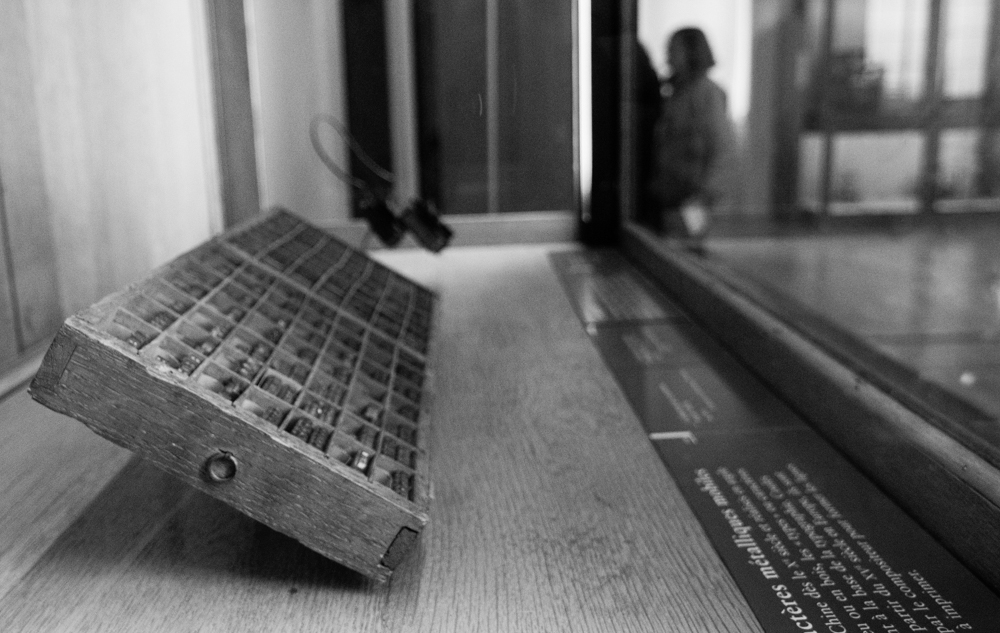
After visiting the Gutenberg Museum in Mainz, a couple aspects of Gutenberg’s revolutionary approach to printing stood out to us. While the museum addressed the historical aspects of printing such as the invention of movable type in China and Korea with wood, clay and some metal in the thirteenth century, Gutenberg’s revolutionary approach truly liberalized mass communication. However, it is important to note that Gutenberg’s style of printing was not always revolutionary for all classes in the until the Protestant Reformation. After all, Gutenberg assisted in printing materials including indulgence forms for the church, comprised of the wealthy upper class nobility.
Despite Gutenberg’s shortcomings, it’s important to reflect on the ways Gutenberg’s invention has green lighted technologically- innovative approaches to spreading mass media today. Personally, we consider today’s use of social media to be a primary example of the way words are consistently being adapted and shared to all audiences. Without Gutenberg’s invention of an efficient way of printing, social movements would not have occurred with such a drastic effect on social outcomes like the Protestant Reformation. Even today, social media movements such as #BlackLivesMatter and #MeToo create opportunities for public discourse through ubiquitous solidarity.
Because the printing press and the invention of moveable type has allowed for the spread of innovation through communication, our media landscape has changed to increase awareness of how connected we really are with the world around us. But social media also creates a danger for volatile movements that aim to misuse these mediums which were originally intended to benefit others. While the printing landscape certainly delved into this territory of evil (especially illustrated with Hitler’s propaganda below), social media and the internet will survive because of their mutualistic beneficial relationship with the public.
On January 8, 2019, our group visited the Documentation Center Exhibition in Nuremberg. The building of the museum consists of the unfinished Congress Hall of the former Nazi party rallies. This infamous site paints a picture on how propaganda was displayed throughout the 1930s through a series of short films and displays of information. By holding an audio translator to our ears, we came to learn the causes, rationality, and effects of National Socialism through the media. Hitler used propaganda to gain support of German so that he could obtain more power.
Propaganda is defined as information, displayed through the media, that may be misleading in order to influence the public opinion. Leni Riefenstahl, a skilled cinematographer and creator of many propaganda films, created a few films for Hitler about Nuremberg rallies. The way she created these films made it seem like Hitler was a hero.
Unfortunately, propaganda still works today. There are striking similarities between Hitler’s rise to power and the media being published today. The Nazi party was able to shutdown mainstream media credibility. Today, many journalists are not trusted by the government and are slowly being destroyed. It was very interesting, and quite chilling, to make connections when eerie information was projected into our ears.
By Abby and Theresa

 Journey Through Media's Impact in Europe